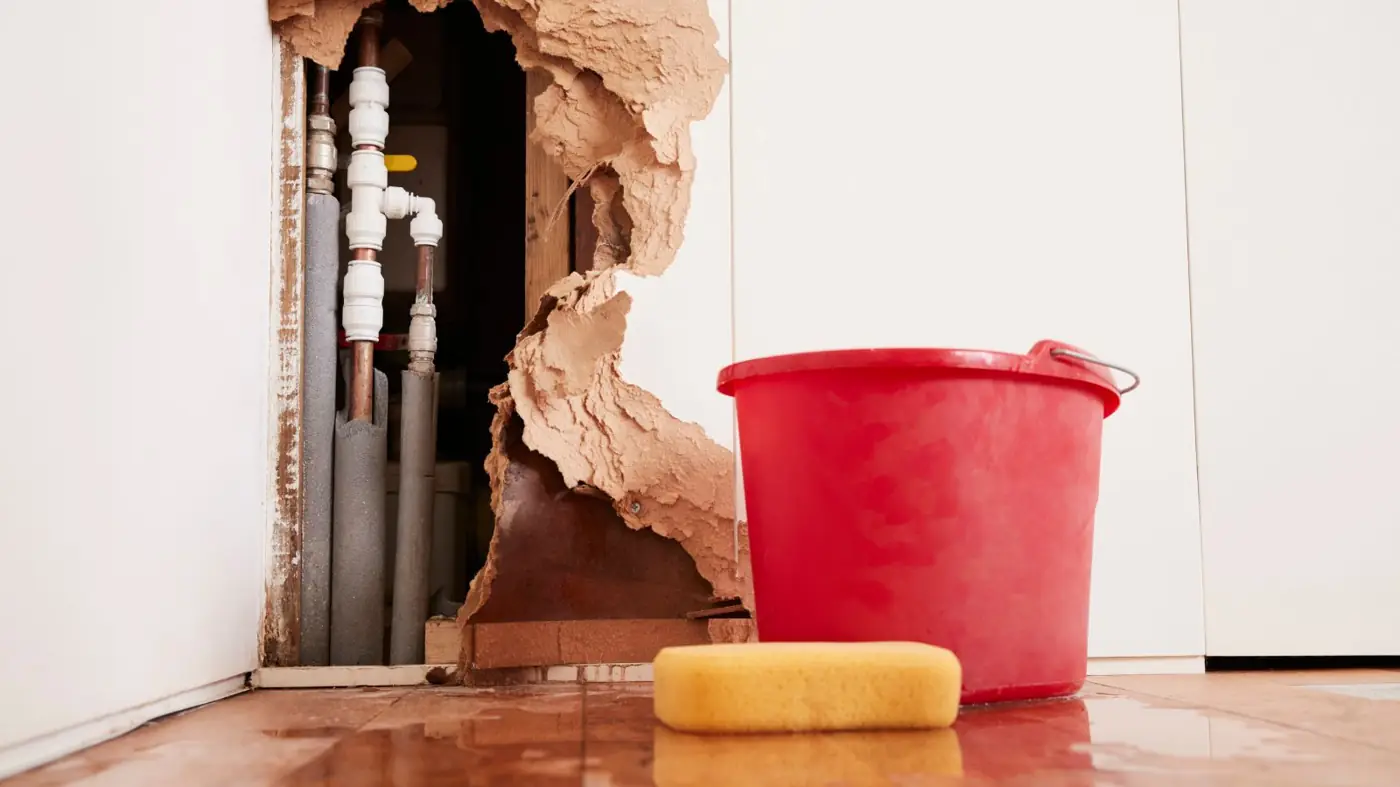
A pipe has burst: do this before anything else
A burst pipe keeps feeding water into the structure until the supply is shut off, so the valve comes first and the phone call comes second. Call (949) 670-0939 once the flow has stopped. Dispatch is 24/7, and we send licensed and insured restoration professionals, with a same-day response when available.
Close the main water valve, then open the lowest faucet in the house to let the pipes drain. Lift rugs, laptops and paper off wet floors. Turn off power to wet areas only if the panel is dry and you can reach it without stepping in water, and stay out of any room where water is coming through a light fixture.
Line split and water still running? Shut it off, then call
Same-day response when available, nights and weekends included. Scope and price are explained before work starts.
What burst pipe water damage is and where it hides
Burst pipe water damage is the soaking of drywall, insulation, framing and flooring after a supply or drain line splits, a joint lets go or a connector fails behind a surface. The pipe is usually out of sight, so the first sign is often a stain, a sound or a soft spot.
The city's Housing Element says most Newport Beach homes were built before 1980, and that housing over 30 years old typically needs some major rehabilitation. Plumbing inside walls is part of that aging. If your house is in the older group, ask a plumber to check the lines in rooms you rarely open, since one failed section is a reason to look at the rest of the run.
Location decides how far the water travels. A split in an upstairs bathroom wall drops water through the floor and into the ceiling below. A failed drain joint above a kitchen soaks the ceiling drywall and the insulation lying on top of it. A line in an exterior wall may show only a damp baseboard while the cavity fills.
Signs a pipe is leaking inside the structure
Some of these show up within minutes of a burst. Others appear for days before anyone connects them.
A ceiling stain that grows or sags
A brown ring that widens, or a ceiling that bows downward, means the drywall is holding water. Bowed board can drop without warning, so stay out from under it.
Running water with every tap closed
Hissing or trickling in a wall points to a pressurized line leaking. If you can see the water meter, check whether it keeps turning with everything off.
Blistering paint
Paint bubbles where moisture pushes from behind. Press a palm flat on the wall: cool and damp means the cavity is wet.
Baseboards that swell or lift
Trim and the bottom edge of drywall wick water upward. Swelling often sits higher than the visible stain.
A sudden drop in water pressure
A full break upstream of a fixture can starve the faucets. Pressure that fails with no outage notice is worth tracing right away.
Burst pipe safety: the first hour
A gas smell, sparking outlets or water pouring through a ceiling light mean you leave first. Call the gas utility or 911 from outside, then call our line. Never wade through standing water to reach a panel or an outlet.
Know who owns the problem. The city Utilities Department lists a water and sewer emergencies line, (949) 644-3011, with the police line, (949) 644-3717, for after hours. If water is surfacing in the street or at the meter, that call is theirs. If it is coming from inside your walls, close your own shut-off, call a plumber for the pipe and call us for the water.
Photograph the wet areas and the failed section before anything is moved. Those photos start the documentation for an insurance claim.
How we dry out after a burst pipe
Day one is a walkthrough, readings on walls, ceilings and floors, and a written scope of work. Scope and price are explained before work starts.
Confirm the water is off
We check that the supply is closed and note which room, wall and floor the water traveled through.
Extract what is standing
Extraction units and wet vacuums pull water from carpet, tile and hard floors before it reaches the subfloor.
Open and map the cavities
Moisture meters and a thermal imaging camera find wet drywall and insulation, and small openings let air reach the framing.
Dry and read daily
Air movers and LGR dehumidifiers stay until daily readings match a dry reference. Then they come out.
What was wet and what usually happens to it
After a pipe bursts, each surface gets its own decision. The readings decide, not how bad the stain looks.
| What got wet | Usual decision | Why |
|---|---|---|
| Ceiling drywall, still firm | Dry in place through small openings | Board that reads dry again does not need to be replaced. |
| Ceiling drywall, sagging or stained through | Cut out and replace | Saturated board loses strength and can fall. |
| Insulation in a wet cavity | Usually removed | It holds water against framing and dries slowly. |
| Lower wall and baseboard | Flood cut a little above the last wet reading | Opens the cavity so the framing can dry. |
| Flooring over a wet subfloor | Check subfloor readings first, see structural drying | The surface can look dry while the layer below is not. |
| A failed drain line | Treat as Category 2 or 3 and remove porous materials | Waste water is not clean. See sewage backup cleanup. |
Categories and classes are defined in the ANSI/IICRC S500 standard. You can ask any company whether its crews work to it.
Flood cut, dry in place or replace: how the call gets made
Nobody should cut into a wall before reading it. A flood cut is a straight cut through drywall, set a little above the highest wet reading, that opens the cavity for drying and lets the crew see the framing.
- Dry in place: small openings or a lifted baseboard, air movers and dehumidifiers, fewer repairs afterward. It works while the board is firm and the readings keep falling.
- Flood cut: faster access to wet insulation and studs, but more patching and painting later.
- Remove and replace: for sagging ceilings and softened board, followed by water damage repair to rebuild.
Mistakes to avoid after a pipe bursts
Closing the valve and walking away is the most common one. Wet insulation and drywall keep holding water long after the flow stops. A box fan cannot reach inside a wall, and the EPA's mold guidance gives 24 to 48 hours as the window to dry wet areas and items.
Painting over a stain, tossing the broken section before photographing it and standing under a bowed ceiling round out the list. Also check the cause. A wet wall near a tank or a washer may not be a pipe at all, so see water heater leak cleanup or appliance leak water damage if the damage sits close to either.
While you wait for the crew
These steps take a few minutes and make the first visit more useful.
Shut the main and keep it shut
Leave the valve closed until a plumber has repaired or capped the line.
Photograph everything
Shoot the failed section, wet walls, ceilings and any damaged belongings from several angles.
Lift what you can
Move rugs, electronics, books and small furniture to dry ground, and leave heavy pieces where they stand.
Stay clear of sagging ceilings
Keep people and pets out of any room with a bowed ceiling or water dripping from a fixture.
Clear a path
Open access to the wet room, the shut-off valve and the garage or side gate where equipment will come in.
What Affects The Price Of Burst Pipe Water Damage
The price follows the scope that moisture readings reveal. These factors move it most.
Water category
A clean supply line is simpler than a drain line, which adds removal of porous materials and cleaning.
Area and floors affected
Water that crossed a second story into a ceiling below means more rooms, more openings and more equipment.
Cutting and access
Insulation removal, flood cuts and ceiling openings add labor before drying even starts.
Drying days and equipment
The number of air movers and dehumidifiers, and how many days they run, depends on how fast daily readings fall.
Rebuild scope
Replacing drywall, paint and trim is a separate repair stage that depends on what had to come out.
A sudden break is the kind of loss many homeowners policies cover, while a pinhole drip over weeks is gradual and often not covered. A plumbing failure and a flood are different claims, and flood is usually excluded. Read your policy, ask your insurer and keep the photos and moisture logs for your claim.
Want your real number? Call (949) 670-0939 and the scope and price are explained before work starts.
Newport Beach Note: street leak or house leak
If the water is in the street, report it through the city's Report a Problem page or the MYNB phone app, and call us for whatever got inside. For nearby jobs, the same dispatch line serves Costa Mesa and Huntington Beach, and you can read about our Newport Beach team or the services overview.
Burst Pipe Questions
Is emergency burst pipe water damage available in Newport Beach?
Yes. Dispatch is 24/7, so nights, weekends and holidays are covered, and a same-day response is available when crews are free. The call will not include a promised arrival time, but it will include what to do first, starting with the main valve.
Do I shut off the water or the power first?
Water first, from the main valve. Power comes next, and only if the panel is dry and reachable without stepping in water. If water is pouring through a light fixture or you smell gas, leave and call the utility or 911 before calling us.
Will the ceiling have to come down?
Not always. Firm drywall that reads dry again can be dried in place through small openings. Sagging, stained-through or crumbling board is cut out. Moisture readings make that call, not the look of the stain.
How soon does mold become a concern after a pipe bursts?
Mold needs moisture, and the EPA's mold guidance gives 24 to 48 hours as the drying window. Drying the cavity is the main step. Health questions belong with a physician.
Who repairs the pipe, you or a plumber?
A plumber repairs the line. Our job is the water: extraction, opening wet cavities, drying and documentation. Having a plumber on the way while crews dry the structure is the usual order.
Does insurance cover a burst pipe?
It depends on the cause. Sudden and accidental breaks are often covered, and slow ones often are not. We provide photos, moisture logs and scope notes for your claim, but approval is up to your insurer.