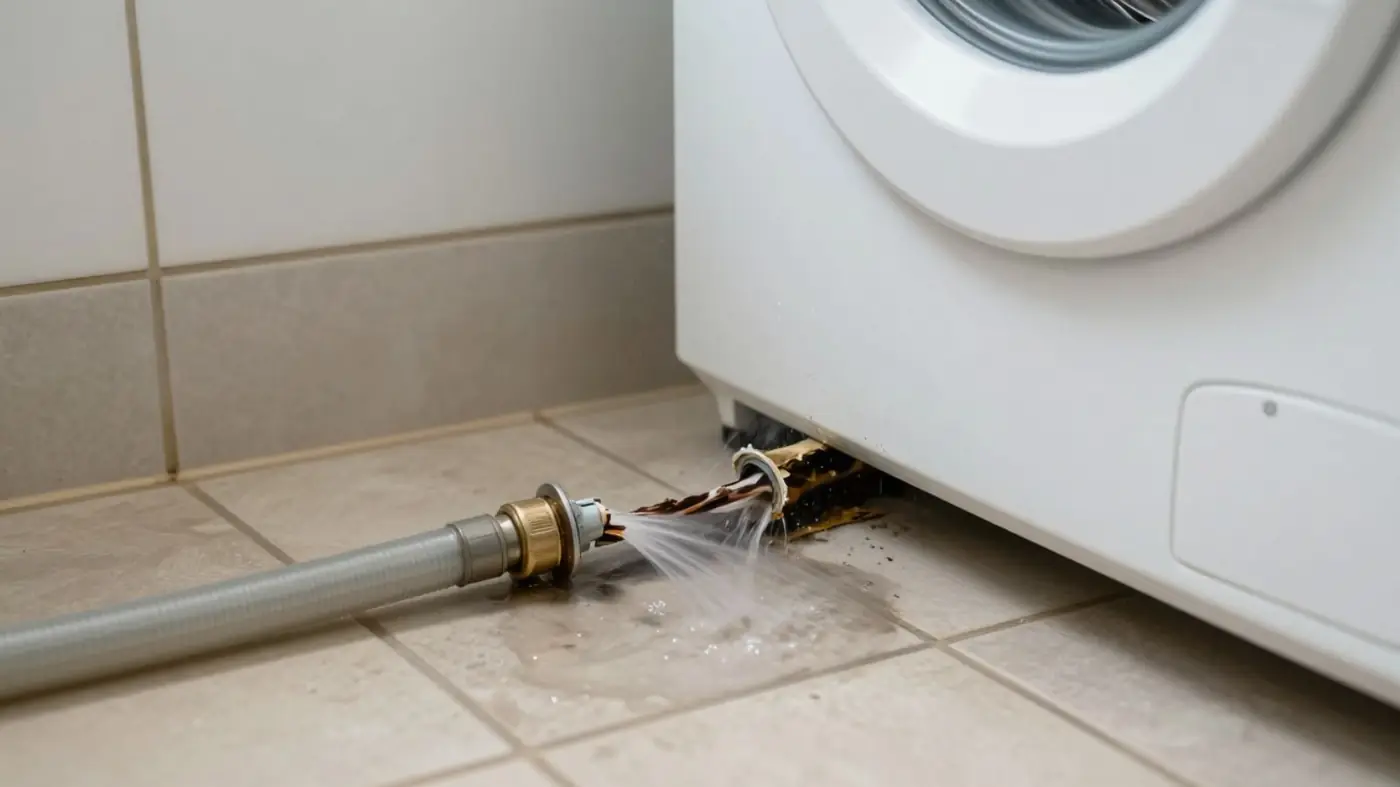
A slow appliance leak still needs drying, and some need a call tonight
Most appliance leaks are not dramatic. A hose weeps behind a washer, a dishwasher drains onto the floor, an ice-maker line drips into a cabinet base. The urgent cases are the ones that kept running while nobody was home. Call (949) 670-0939 any time, since dispatch is 24/7 and a same-day response is available when crews are free.
Close the shut-off valve for the appliance, or the main water valve if you cannot find it. Unplug the unit only if the outlet and floor around it are dry. If water has reached outlets or the panel, leave the power alone, keep people and pets out of the room and tell us when you call.
Floor wet around a machine? Get the readings before it spreads
Same-day response when available. Scope and price are explained before work starts.
How appliance leaks happen, and why they are easy to miss
Appliance leak water damage is the wetting of flooring, subfloor, cabinets and drywall after a supply hose, drain hose, valve, gasket or pan fails. Unlike a burst pipe, the water often arrives slowly and from behind a machine, so it is found late.
The city's Housing Element lists about 47.8 percent of homes as single-unit detached and 34.5 percent as multi-unit. The housing type changes where the water goes. In a detached house, a laundry room leak soaks the slab or floor framing. In an apartment or condo, the same leak drops through the floor into the unit below, which makes the neighbor's ceiling part of your repair.
Which appliance leaks where
Each machine fails in its own way, and each leaves a different wet pattern.
| Appliance | Common failure | What usually gets wet |
|---|---|---|
| Washing machine | A fill hose bursts or a drain hose slips off the standpipe | Laundry floor, wall base, and the ceiling below if upstairs |
| Dishwasher | A door gasket, supply fitting or drain line leaks | Cabinet base, toe kick, and flooring under the kitchen, see kitchen water damage |
| Refrigerator | An ice-maker or dispenser line drips behind the unit | Flooring under and behind the fridge, and the subfloor |
| Water dispenser or ice machine | A loose fitting or overflowing drain | Cabinet or closet floor, usually unseen for days |
| Any unit with a pan | A pan overflows or its drain clogs | Whatever lies below the pan, often a ceiling |
A leak near a water heater is handled differently. See water heater leak cleanup.
Signs an appliance has been leaking
Look for these before the stain appears.
Cupped or lifting floor near the unit
Boards and laminate edges lift as the layer below takes on moisture. Check the floor around the washer and under the fridge first.
A musty smell from the cabinet or laundry closet
Odor with no visible water points to a wet base, pad or wall cavity. A moisture meter and a thermal imaging camera can find it.
Soft or dark cabinet bottoms
Particleboard swells quickly when wet. A cabinet floor that crumbles under a fingertip has been wet for a while.
A ceiling stain in the unit below
If you live above someone, their stain may be the first sign. Check your washer and dishwasher the same day.
A higher water bill
A leak that runs while the house is empty can raise the bill with no visible puddle.
Appliance leak safety in the first hour
Water and electricity are the real hazard. Do not pull a heavy washer or refrigerator across a wet floor, since wet floors are slippery and tipped hoses can start the flow again. Close the valve, then photograph the area and the failed part before anything is moved.
For an upstairs leak, knock on the door below, and tell the building manager or HOA right away. If the water is gray or smells like sewage, as it can when a washer drain backs up, keep out of it and say so on the phone. We can send crews for water damage cleanup once the area is safe.
How we dry out after an appliance leak
An inspection visit covers a walkthrough of the room, readings on floors, cabinet bases and walls, and a written scope. Nothing starts until the scope and price are explained.
The published ANSI/IICRC S500 standard defines the water categories and drying goals, so ask any company whether its crews work to it.
Find the edges
Moisture meters and a thermal imaging camera show how far the water traveled under flooring and behind cabinets.
Extract
Extraction units pull water from carpet, pad and hard floors.
Open what must open
Toe kicks, baseboards and sections of flooring come off so air reaches wet subfloor and wall bases.
Dry and verify
Air movers and dehumidifiers run while daily readings fall toward each material's dry reference.
Dry in place or replace: what the numbers decide
Tearing out flooring that could have been dried is an expensive habit, so ask for moisture readings before you agree to any removal. Hardwood and engineered boards can often be dried with floor mats if the leak was caught early, while swollen particleboard cabinets and wet carpet pad are usually replaced.
Readings can also prove a floor is dry, which supports the case for keeping it. For finished floors, see hardwood floor water damage and carpet water damage for how those materials are treated.
Appliance leak mistakes, and how to prevent a repeat
The usual mistakes are running the machine again to test it, wiping the surface and calling it done, and leaving a damp cabinet closed. Mold needs moisture, and a closed cabinet base holds it. The EPA's guidance on mold and moisture puts the target at 24 to 48 hours for drying wet areas and items.
Prevention is cheap by comparison. Look at hoses for bulges, cracks and rust at the couplings, and replace any that look worn. Turn off the washer supply when you travel.
- Pull the dishwasher and refrigerator forward once or twice a year and check the floor behind them.
- Make sure drain hoses sit firmly in the standpipe.
- Put a battery leak alarm under the sink, the washer and the fridge.
- Ask a plumber about a drain pan with a drain line for any upstairs washer.
What Affects The Price Of Appliance Leak Water Damage
Price follows the scope that readings reveal. These factors matter most.
How long it leaked
A leak found in an hour is a drying job. One found after weeks may involve subfloor, cabinets and wall cavities.
Water category
Clean supply water is simpler than gray water from a washer drain, which adds removal and cleaning.
Materials involved
Some materials, like carpet pad, are cheaper to replace than to dry. Hardwood is often worth drying.
Rooms and floors affected
A unit above a neighbor can double the scope.
Equipment and days on site
The count of fans and dehumidifiers and the days they run follow the daily readings.
A hose that lets go suddenly is the kind of event policies often cover, while a slow drip over months often is not. Flood is usually excluded and needs separate coverage. Your policy and your insurer have the final say, so ask them, and hold on to the photos, moisture logs and the failed part.
Want your real number? Call (949) 670-0939 and the scope and price are explained before work starts.
Newport Beach Note: shared walls and shared floors
About a third of Newport Beach homes sit in multi-unit buildings, so an appliance leak is often a neighbor's problem as well. Report it to the building manager before work begins and ask who authorizes drying in the shared areas. Crews also serve Laguna Beach and Tustin, and the full list of work is on the services overview. For a pipe in the wall rather than a hose, see burst pipe water damage.
Appliance Leak Questions
Is emergency appliance leak water damage cleanup available in Newport Beach?
Yes. Dispatch is 24/7, with a same-day response when available and no promised arrival time. A leak that is still running or has reached a floor below is the urgent kind. Close the valve first, then call.
The washer hose burst while I was out. What now?
Close the valve, keep out of the water if outlets are wet, and photograph the area. Then call for extraction and readings. Water that ran for hours has usually reached the subfloor, so the surface can look drier than it is.
Can I dry the floor myself with fans?
For a small spill on tile, yes. For anything that got under cabinets, flooring or a wall base, fans without readings are a gamble. The EPA's mold guidance names 24 to 48 hours as the window for drying.
My refrigerator leaked behind it for weeks. Is that different?
Yes. Long leaks reach the subfloor and the cabinet or wall base, so the scope is bigger. Long seepage is gradual damage, which policies often exclude, so check your policy.
Does insurance cover an appliance leak?
A sudden failure is often covered. A slow one often is not. Read your policy and ask your insurer. Documentation comes from us, approval does not.