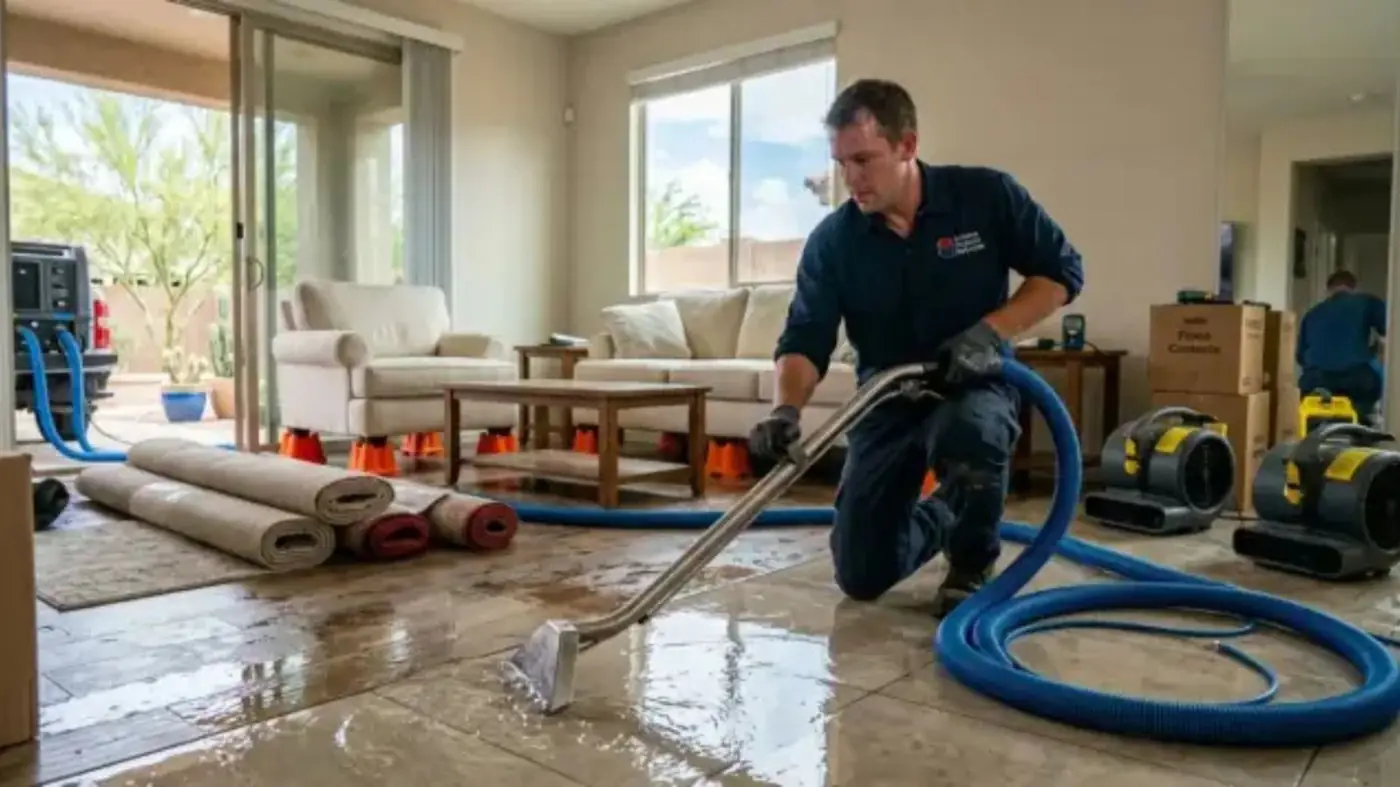
When standing water is an emergency
Standing water is an emergency from the first inch. It soaks into carpet pad, wicks up drywall and seeps into subfloors, and the longer it sits the more of the house it reaches. Call (949) 670-0939 and dispatch picks up 24/7, with a same-day response when available.
Before anyone arrives, close the main water valve, stay out of water that touches outlets or appliances, and keep children and pets away from it. Move furniture legs off wet carpet, lift anything valuable to a dry surface, and take photos of the water level before you touch a thing.
Electricity, gas and sewage come before the restoration call
If water has reached outlets, a panel or a plugged-in appliance, do not wade in. Turn off power at the panel only if it is dry and you can reach it without standing in water, otherwise call the electric utility or 911. If you smell gas, leave the house and call the gas utility or 911 first.
Sewage is a different hazard. If wastewater is backing up from a floor drain or toilet and you think the problem is in the street, the city's water and sewer emergencies line is (949) 644-3011, and after hours the city lists the Police Department line (949) 644-3717. Keep everyone out of the water, then call us for removal and sanitizing.
Standing water right now?
Call (949) 670-0939. Dispatch is 24/7 and scope and price are explained before work starts.
Burst Pipe Water Damage
A burst pipe moves fast. Start at the main shutoff, usually where the supply line enters the house, and turn it fully off. If you cannot find or turn it, check your water bill to see whether the City of Newport Beach or another district, such as Irvine Ranch Water District or Mesa Water District, supplies your address, then call that provider.
Different failures leave different messes. A burst supply line inside a wall can run for hours behind the paint. A cracked washer hose or a failed washer valve floods a laundry room and runs under the flooring. A water heater that splits dumps its whole tank at once. A line under a sink soaks the cabinet floor and spreads along the toe-kick.
Document before cleanup. Take photos and video of the source, the water line on walls and cabinets, and every damaged item, and keep the failed part if you can. Then call so the water can be extracted and the wet cavities read with a moisture meter. See water mitigation for what happens after the water is out.
Common sources of standing water in a Newport Beach home
The source tells the crew what kind of water they are dealing with and where else it has gone.
Under-sink line or fixture
Often a slow leak that goes unseen until the cabinet floor is soft. Pull everything out, shut the angle stop and photograph the damage.
Washer valve or hose
A sudden break puts a steady stream on the floor. Close the washer valves, or the main if they will not turn.
Water heater failure
Shut off the cold water supply to the tank and the power or gas to the unit. A full tank is a large volume of standing water.
Crawl space
Water pooled under a raised floor soaks insulation and joists where nobody looks. It needs a submersible pump and hose run, not a mop.
Whole-house flooding
After a heavy storm or a major supply failure, water can cover every room at once. Crews work room by room and may run several pumps at the same time.
How standing water is pulled out of the house
An inspection visit covers a walkthrough, moisture readings and a written scope before work starts, and the photos and notes help support an insurance claim. Extraction itself follows a set order.
Safety check
The crew checks for electrical risk, gas smell and sewage before any equipment is plugged in.
Pump the deep water
Submersible pumps and hoses move several inches of water out of rooms, garages and crawl spaces.
Extract the rest
Truck-mounted or portable extraction units and wands pull water from carpet, pad and hard floors.
Hand off to drying
Moisture meters check walls and subfloors, and air movers go in so the structure can dry.
What gets used on which surface
The same inch of water calls for different tools depending on what is under it. Here is how the usual cases are handled.
| Where the water is | Equipment used | What happens next |
|---|---|---|
| Tile, vinyl or sealed concrete | Submersible pump, wet extraction wand | Surface dries quickly. Check baseboards and cabinet bases with a moisture meter. |
| Carpet and pad | Weighted extraction tool, then air movers | Pad is often removed and replaced, carpet may be saved if the water was clean. |
| Hardwood or laminate | Extraction wand, drying mats and air movers | Boards may cup. Water damage repair follows if they cannot be dried flat. |
| Crawl space or garage | Submersible pump, long hose runs | Insulation and exposed framing are checked for moisture. |
| Sewage or storm water | Pump, extraction, protective gear | Treated as contaminated. Porous materials are removed and the area is cleaned and sanitized. |
Clean supply-line water can turn into contaminated water if it sits, so the sooner the water is out, the more can be saved.
Newport Beach Note: harbor tides and low-lying streets
The city's king tide advisory says evening high tides may cause localized flooding in low-lying harborfront areas, including the Peninsula, Balboa Island, Balboa Village, Newport Island, Finley Tract and Lido Village. The regional hazard-mitigation annex adds that rising ocean levels are causing flooding more often on Balboa Island and the Balboa Peninsula.
If you own property next to the harbor, the city suggests seawall plugs and sandbags in vulnerable spots. Prefilled sandbags are at the City Corporation Yard, 592 Superior Avenue, and unfilled bags are at city fire stations. Tide-driven water can be salty and dirty, so treat it as contaminated and call before you scoop it by hand.
Pump it yourself or call a crew?
A shop vacuum is fine for a puddle by the dishwasher. It is not fine for a few inches over a whole floor, water near outlets, or anything that smells like sewage, and it cannot pull water out of a carpet pad, which is where most of it sits.
- Shop vacuum: low cost and fine for a small spill on a hard floor, slow and unsafe if power is wet.
- Crew with pumps, extraction units and meters: removes the water, measures what is left and leaves a written scope.
What Affects The Price Of Emergency Water Removal
Removal is priced on how much water, how dirty it is and how hard it is to reach, not on a flat call-out rate.
Depth and square footage
A flooded garage or lower-level room takes more pump time than a damp kitchen floor.
Water category
Category 3 water adds protective gear, disposal and sanitizing.
Access
Crawl spaces, tight garages and stairs slow the hose runs and the extraction work.
What it soaked into
Carpet over pad, hardwood or insulation each need a different method.
Sudden and accidental water, like a burst line or failed hose, is often covered by homeowners insurance, while gradual leaks often are not. Check your policy and ask your insurer, and keep your photos and the failed part for the claim.
Want your real number? Call (949) 670-0939 and the scope and price are explained before work starts.
Newport Beach Note: where we send crews
Dispatch covers Newport Beach ZIP codes 92660, 92661, 92662 and 92663, day or night. The same line also serves Huntington Beach. If the flooding is storm-driven and reaches more than one room or level, read about flood damage restoration, or start from the page for our Newport Beach team.
Water Removal Questions
Do you handle emergency water removal at night or on weekends in Newport Beach?
Yes. Dispatch is 24/7 and a same-day response is available when crews are free. No arrival time is promised, but the dispatcher tells you what to shut off and what to move while you wait.
A pipe burst under my sink. What should I do first?
Close the angle stop under the sink, or the main water valve if it will not turn. Move items out of the cabinet, take photos, and call. The cabinet floor and the wall behind it need moisture readings even if the cabinet looks dry.
My washer valve broke and water is in the hallway. Can the carpet be saved?
Often yes, if the water was clean and extraction starts quickly. The pad usually has to be replaced, and a moisture meter confirms whether the subfloor needs drying.
How is the water actually removed?
Submersible pumps move deep water and extraction units pull water from carpet and hard floors. Moisture meters then check what is left in the walls and subfloor.
What if the water came from a storm or the sewer?
Stay out, call the utility or 911 first if there is an electrical or gas risk, and call us for removal. That water is treated as contaminated and porous materials are usually removed.