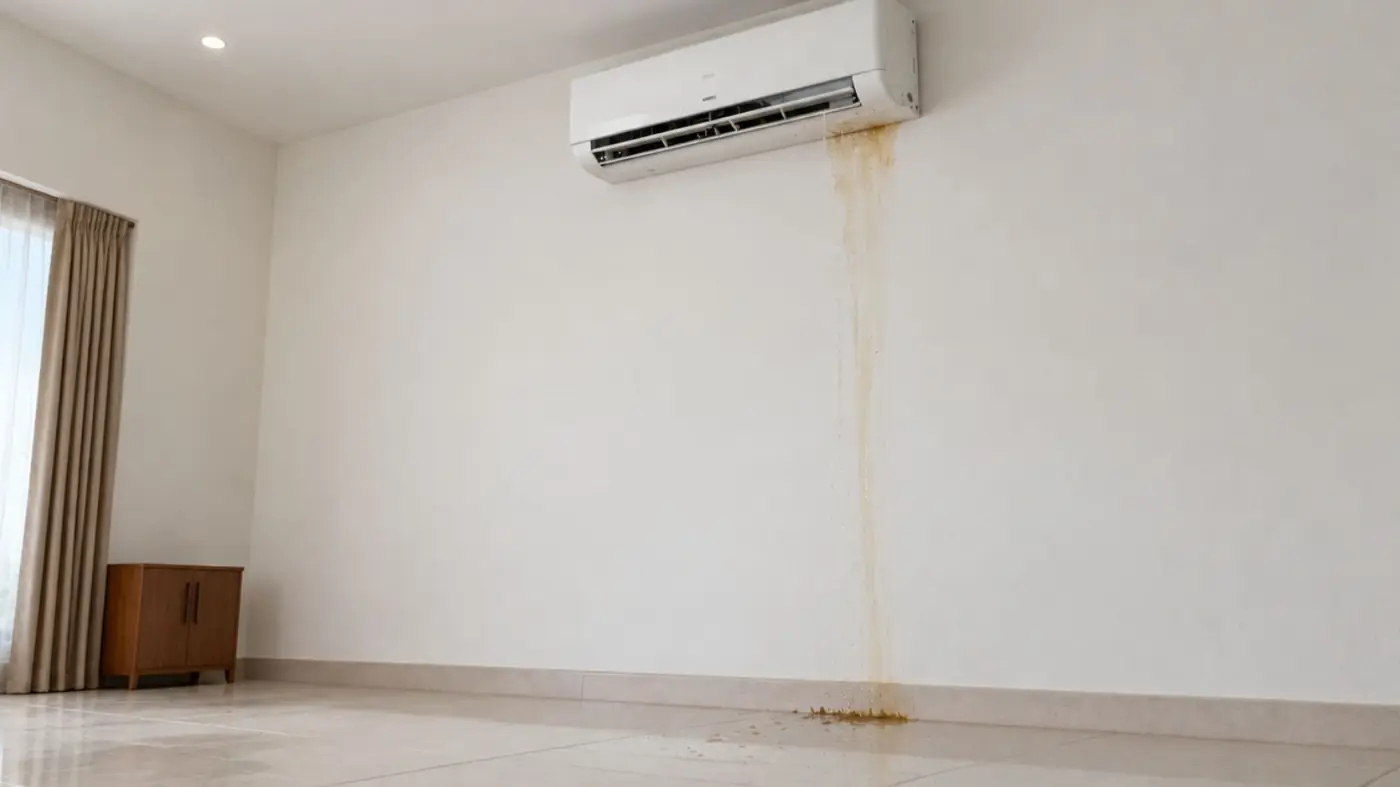
How An AC Leak Becomes Water Damage
AC leak water damage is the wet ceiling, drywall, insulation or flooring left when a cooling system drips or overflows condensate. The system pulls moisture out of indoor air, and that water is meant to leave through a drain line. When the line clogs, the pan beneath the coil fills and spills. Many of these leaks are slow, which is why the damage is often found late.
Where the unit sits decides what gets wet. An attic unit soaks insulation and the ceiling below it, a closet unit wets the floor and wall bases, and a unit in a ceiling space can drip into the room underneath.
Dripping from the vent or ceiling?
Call (949) 670-0939. 24/7 dispatch, same-day response when available, and the scope and price are explained before work starts.
What You See And What It Means
A stain is the late part of the story. Behind it, insulation may be wet and drywall soft.
A brown ring or sag in the ceiling
Water pooled above the drywall. A sag means the board is holding weight and may release it suddenly.
Water around the indoor unit
A puddle in a closet, garage or under an attic hatch points to a full pan or a blocked drain.
The system quits on a hot day
Some systems have a float switch that shuts the unit off when the pan fills. A sudden stop can be that switch doing its job.
A musty smell at the vents or closet
Damp insulation and a wet pan smell stale. The odor usually means moisture has been present for a while.
Ice on the coil or lines
Ice that melts can send more water than the drain line was built to carry. Call an HVAC technician for the cause.
AC Leak Safety Steps: What To Do First
Turn the system off at the thermostat, which stops it from making more condensate. If water sits near the air handler or its electrical connections, turn off its breaker only if the panel is dry and safe to reach. A bulging ceiling can release water suddenly, so keep people out from under it.
Set a bucket under any drip, move rugs and furniture, and soak up what you can reach with towels. Photograph the stain, the pan and the drain before anything is changed.
The EPA advises drying water-damaged areas and items within 24 to 48 hours to prevent mold growth. That window is why a slow AC leak is not a case to leave for next month. Call an HVAC technician for the system, and call us for the wet materials.
The HVAC Technician Fixes The Drain, We Dry The Damage
A clogged condensate line, a cracked pan or a failed float switch is an HVAC repair. We do not service cooling systems. If the cause stays, the drip returns after our work is done.
Our side begins with moisture meters and a thermal imaging camera that show how far water spread above a ceiling or behind a wall. Ask any company whether its crews work to the ANSI/IICRC S500 standard for water damage restoration. Then the drying starts.
How AC Leak Damage Is Dried
Attics and closets are hot, tight spaces, so equipment is placed to suit them.
Find the wet area
Moisture meters and thermal imaging trace the water across ceilings, wall cavities and floors.
Remove what cannot recover
Soaked insulation and soft drywall are cut out, and a sagging ceiling section is opened so trapped water drains in a controlled way.
Dry the structure
Air movers and LGR dehumidifiers pull moisture from framing, drywall edges and flooring.
Verify and document
Repeat readings confirm dry levels. Photos, moisture logs and scope notes are kept for a claim.
Dry In Place Or Cut Out: How The Choice Is Made
The call depends on what is wet and how long it has been wet.
| What got wet | Often dried in place | Often removed |
|---|---|---|
| Ceiling drywall | Firm, lightly stained and reading dry quickly | Sagging, soft or crumbling |
| Attic insulation | Only if damp briefly | Matted or soaked batts and loose fill |
| Wall base and trim | Dried through small openings | Swollen or crumbling |
| Carpet and pad | Carpet dried after extraction | Pad pulled when saturated |
| Wood flooring by a closet unit | Dried with mats if caught early | Cupped or stained boards |
The written scope names each item and the reason it was kept or removed.
Why A Slow AC Leak Turns Into A Mold Question
Mold needs moisture, and a drain line that drips a little on every cooling day supplies it on a schedule. Closed attics and closets stay damp longer than open rooms. If growth is visible, mold remediation follows the ANSI/IICRC S520 standard, and health questions belong to a physician.
The EPA suggests keeping indoor relative humidity below 60 percent, ideally between 30 and 50 percent, and keeping AC drain lines clear. A simple hygrometer reads humidity. A clear drain line is a question for your HVAC technician.
Condos, Apartments And The Unit Below You
The city's Housing Element, drawing on 2018 census survey figures, counts about 44,800 housing units in Newport Beach, with 34.5 percent in multi-unit buildings. It also reports that 43.5 percent of occupied units are rented and that 67.9 percent of renters live in multi-unit buildings. In a stacked building, an overflowing drain can reach the neighbor's ceiling, so tell your landlord or association the same day.
Ask who owns the repair and the claim before work starts, because tenants, owners and associations carry different responsibilities and policies. We document damage with photos, moisture logs and scope notes so everyone works from the same record.
How To Prevent The Next AC Leak
Ask the HVAC technician to flush the condensate line and check the pan at each service visit. Ask too whether a float switch or a secondary pan is fitted, since both give an early warning.
Look at the ceiling under an attic unit and the floor around a closet unit every few months, especially after long hot spells. A small stain caught early is a towel job. A large one is a drywall job.
What Affects The Price Of AC Leak Water Damage Repair
An AC leak can be one ceiling patch or a whole hallway. These factors set the scope.
Where the unit sits
Attic and ceiling-space units take more setup time than a closet unit with a clear floor.
How long it leaked
Long, slow leaks reach more insulation, drywall and trim than a one-day overflow.
Materials affected
Insulation comes out quickly. Drywall, wood flooring and cabinets take more labor.
Drying days and equipment
Thicker materials and more rooms mean more air movers and dehumidifiers for more days.
Rebuild scope
Restoration ends at a dry structure. Ceiling patching, texture and paint are priced separately, as is the HVAC repair.
An overflow on one hot afternoon reads as sudden. A drain that dripped for weeks can be read as gradual, and gradual leaks and neglect often are not covered. Check your policy and ask your insurer how it treats condensate and long-term seepage. An indoor AC leak is a plumbing-type loss, not a flood, and flood coverage is a separate policy.
A dated photo of the stain and the pan, plus readings from the ceiling, make a claim easier to explain.
Want your real number? Call (949) 670-0939 and the scope and price are explained before work starts.
Newport Beach Note: Permits And Neighbors
Ask the city Building Division whether ceiling or drywall repair after an AC leak needs a permit. If you rent, the same question goes to your landlord first.
The dispatch line also takes calls from Irvine and Tustin. If the leak started as a pipe rather than a drain line, see burst pipe water damage, and for a wet appliance, see appliance leak water damage.
AC Leak Questions
Is emergency AC leak water damage repair available in Newport Beach?
Yes, dispatch is 24/7 and same-day response is offered when available, though no arrival time is promised. An AC leak is rarely a burst pipe, but the urgent part is stopping the system and starting to dry within 24 to 48 hours. Call (949) 670-0939.
Do you repair the air conditioner or the drain line?
No. A clogged line, a cracked pan or a bad float switch is an HVAC repair. We dry the ceilings, walls and floors the water reached.
Should I turn the AC off if it is leaking?
Yes, at the thermostat, so it stops making condensate. Then have an HVAC technician find the cause before the system runs again.
Can I paint over a ceiling stain after an AC leak?
Not until the ceiling reads dry. Paint hides the stain but not the moisture, and the EPA says not to paint or caulk over mold. A moisture reading tells you where things stand.
How long can a wet ceiling wait before mold becomes a worry?
The EPA points to 24 to 48 hours for drying water-damaged areas. Beyond that, mold becomes more likely wherever moisture lingers, which is why a slow leak deserves a prompt call.
Will insurance cover AC leak water damage?
It depends on the policy and the cause. Sudden and accidental damage is often covered, and gradual leaks often are not. Check your policy and ask your insurer.