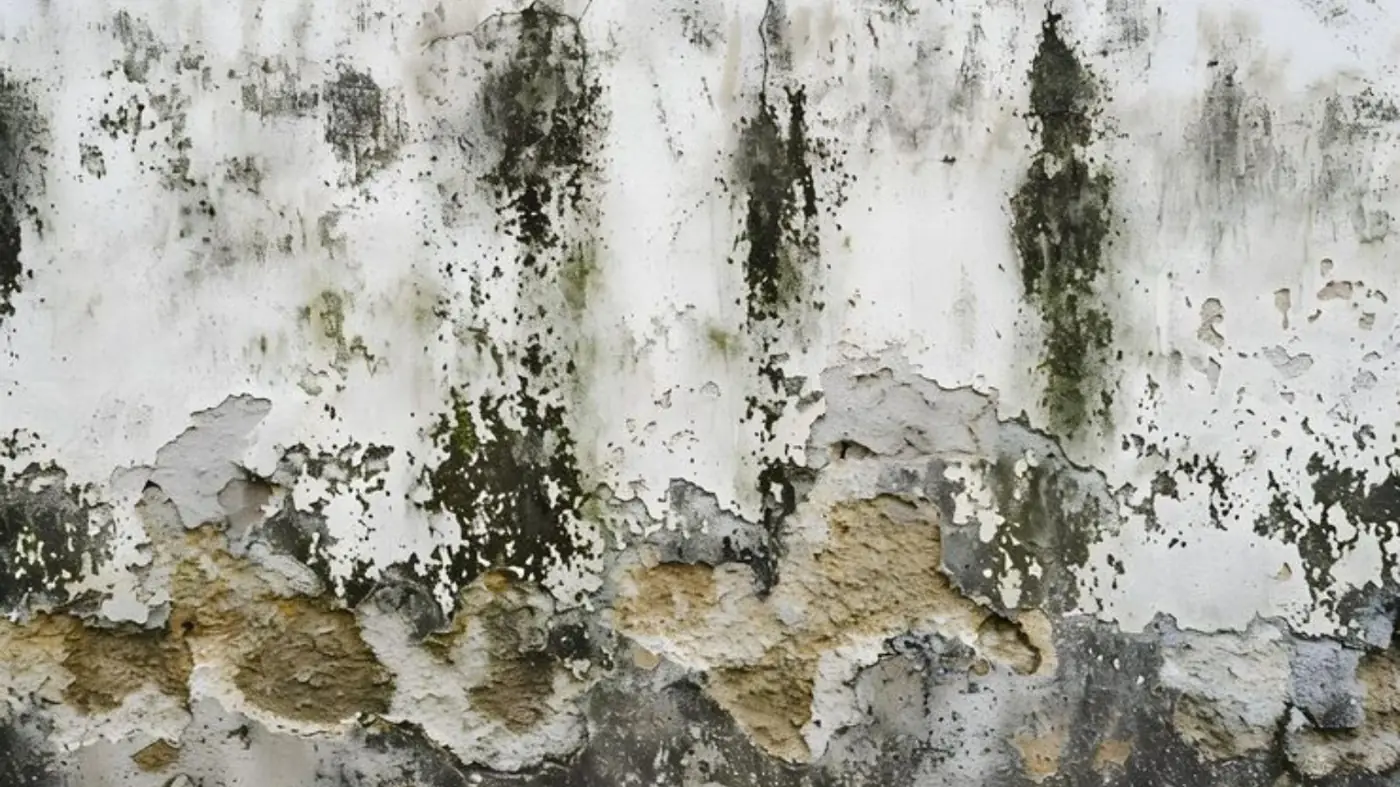
The Look: Color, Texture and Pattern
Mold has no single look. It shows up as black, gray, green, white, brown or even orange and pink, and the color does not identify the type. What stays consistent is the pattern: it grows in irregular clusters, spreads outward from a damp spot and tends to be darker where the moisture is greatest.
Texture helps. Fuzzy or cottony growth is common on drywall and fabric. Powdery growth looks like dust that clings to a surface. Slimy patches show up on very wet materials, and spotty freckles of dark dots appear on painted ceilings and grout. A stain with no raised texture can still be mold, since growth on a painted surface may just look like a smudge.
Not sure what you are looking at?
Call (949) 670-0939 and describe the spot. Same-day response is offered when available.
What You See, Where, and What To Do
Use this as a first pass. Match the spot, then find the moisture source before you touch the growth.
| What you see | Where | Likely moisture source | Next step |
|---|---|---|---|
| Dark speckles, firm paint | Bathroom ceiling corners, above the shower | Steam and a weak exhaust fan | Clean if under 10 square feet, vent the fan outdoors |
| Black or green smears, musty smell | Behind baseboards, along an exterior wall | Wicking from a slab or a leaking roof edge | Check with a moisture meter, lift the baseboard |
| Dark fuzz, sometimes with drips | Under sinks, inside cabinet backs | Weeping trap or supply line | Repair the leak, remove soft material |
| Brown or black ring on the ceiling | Below a bathroom, near the AC drain line | Overflow or a clogged condensate line | Clear the line, check the ceiling cavity |
| White crystals that brush off dry | Concrete, brick, stucco or block walls | Water moving through masonry, leaving mineral salts | This is not mold. Find where the water comes in |
Dirt usually wipes away in one pass. Mold smears, returns or keeps a musty smell after cleaning.
Where Mold Hides Before You See It
The first sign is often the smell. A musty, earthy odor that comes and goes points to growth behind a surface you cannot see. Pull a few things out to look at: the back of a bottom cabinet, the underside of a vanity, a closet wall shared with a bathroom, and the closet that houses the AC air handler.
Behind baseboards is a favorite spot, because water from a slab or an exterior wall wicks up into the bottom of the drywall. Ceiling corners hold condensation. Around an AC drain line, a slow drip can keep a patch wet for months. A flashlight held at a low angle across the wall shows texture changes that a straight look misses.
Mold, Dirt or Efflorescence?
Dirt collects in predictable places, like air vents and corners with poor circulation. It wipes off cleanly and does not spread. Soot and smudge from candles leave a flat, even film.
Efflorescence is a mineral salt deposit that forms when water moves through concrete, brick or stucco and evaporates. It is white or gray, crystalline and dry. It is not mold, but it still means water is getting in. A simple check is to rub it: salts crumble or dissolve in a damp cloth, while mold smears and often has an odor.
What To Do When You See Mold
Fix the water source first, since mold needs moisture. Dry the area within 24 to 48 hours if the cause was a sudden leak. If the patch is under about 10 square feet on a hard surface, the EPA says homeowners can scrub it with detergent and water, dry it, and wear an N-95 respirator, gloves and goggles without ventilation holes. Do not use bleach routinely, and do not paint over it.
Sampling is usually unnecessary when mold is visible. For larger patches, wet materials or recurring growth, call a mold remediation company that follows the ANSI/IICRC S520 standard. Health concerns go to a physician, not to a photo comparison.
Newport Beach note: Where You Live Changes the Moisture Source
The city's flood information splits Newport Beach into low-elevation areas, including West Newport, the Balboa Peninsula and Newport Bay, an elevated marine terrace with Newport Heights and Westcliff, and high-relief terrain in the San Joaquin Hills. It also lists steep natural streams at Newport Ridge and Newport Coast, and mudflow risk where development sits at the base of mountains.
In practice, check the ground floor first if you live in a low area, since water from storms or tides enters at ground level and wicks up walls. On the terrace, start with roof edges, gutters and bathroom vents. On a slope, look at lower walls that face uphill and at where the downspouts empty. Homeowners in Laguna Beach and Tustin use the same walk-through, just with a different list of likely culprits.
When Mold Shows Up After Storm Water
Growth that appears after a storm or tide event is often a sign that the structure was not dried in time. If water entered the home from outside, flood damage restoration crews extract the water, remove wet materials and dry the structure before mold work starts. Photograph the area, keep a note of dates and ask your insurer whether flood coverage applies, because standard homeowners insurance does not cover flood damage.
Do not wait to see whether the growth fades. Wet drywall, baseboard and carpet pad that stay damp past the 24 to 48 hour window tend to be the materials that need to be cut out, so an early moisture reading often saves more of the house.
What Mold Looks Like: Questions
Is all black staining mold?
No. Soot, dirt, soap scum and some stains can look dark. Wipe a small spot with a damp cloth. If it smears, returns or has a musty smell, treat it as mold and check for moisture.
What color is dangerous mold?
Color alone does not tell you. Any growth on indoor materials should be cleaned or removed and the water problem fixed. If you are worried about your health, ask a physician.
Can mold grow inside walls without showing?
Yes, if the cavity stays damp. A musty smell, bubbling paint or a stain that returns are clues. A moisture meter and thermal imaging camera can locate wet areas without opening the wall.
Does white powder on a wall mean mold?
Not always. White crystals on concrete, brick or stucco are often efflorescence, a mineral deposit. It still signals water movement, so look for the source.
I live in West Newport. Where should I look first for hidden mold?
Start at ground level because the city lists West Newport among its low-elevation areas. Check baseboards, the lowest cabinet backs, garage-adjacent walls and any slab edge. Use a moisture meter if you have one, and call (949) 670-0939 if readings are high.