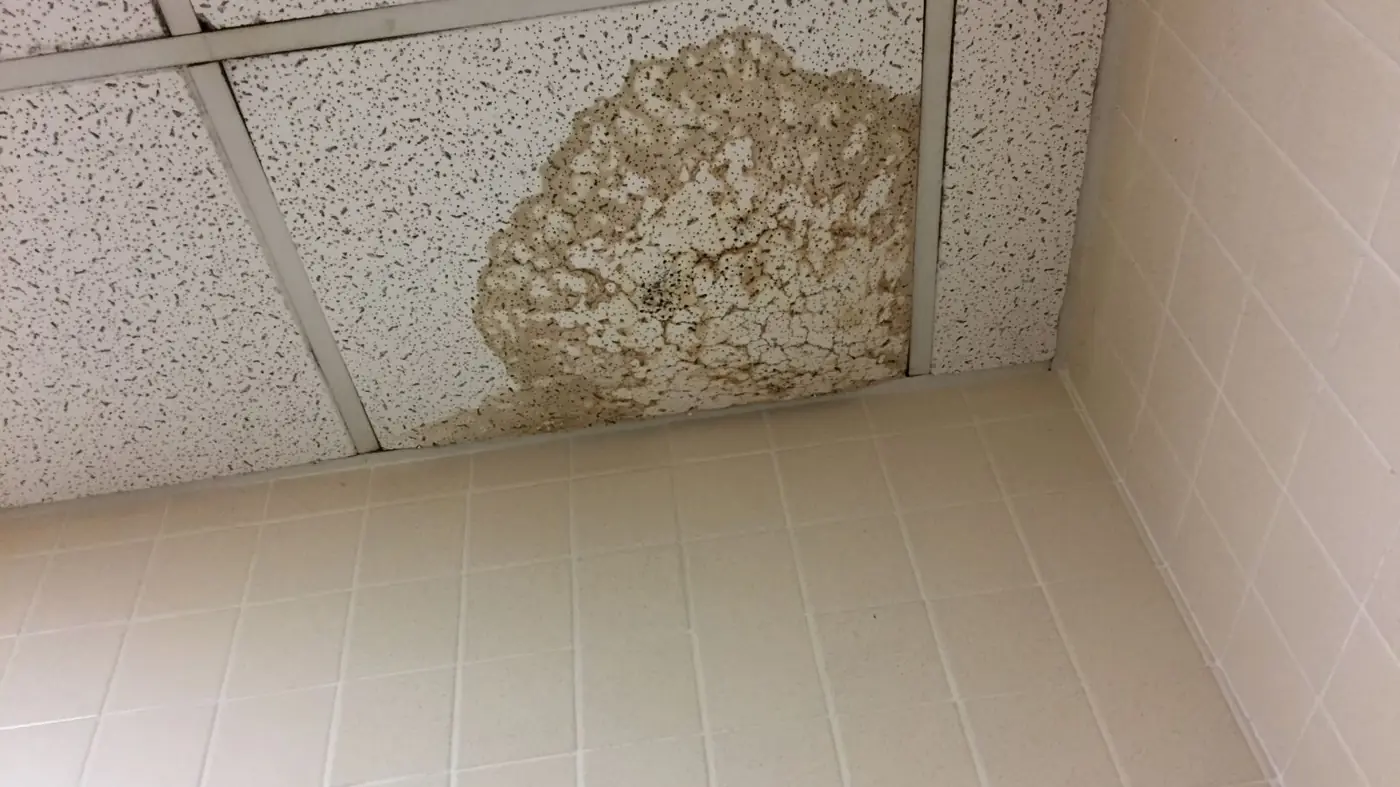
Why a Ceiling Stain Is Never Just a Stain
Water rarely shows up directly under its source. It runs along joists, pipes and the top of drywall until it finds a low spot, a seam or a screw hole, and only then does it drip or stain. So the mark you see is the end of a path, not the start.
Four causes account for most ceiling stains: a roof leak, a supply or drain pipe in the floor above, a clogged AC condensate line and moist air condensing from a bathroom vent. Each leaves a slightly different signature.
Not sure where it is coming from?
Call (949) 670-0939. 24/7 dispatch, same-day response when available.
What Each Type of Ceiling Stain Usually Means
No chart is perfect, but these patterns point the right direction before anyone opens the ceiling.
| What the stain looks like | Likely cause | What to check |
|---|---|---|
| Brown rings that darken after rain and fade in dry weather | Roof or flashing leak | Attic underside, roof penetrations, ceiling directly below the roof |
| Stain under a bathroom, kitchen or laundry, active in any weather | Supply line, drain or appliance hose above | Fixture valves, shower pan, tub overflow, washing machine box |
| Wet patch near an air handler or vent, worse on hot days | AC condensate line or drain pan | Drain line for clogs, pan for standing water, insulation on ducts |
| Scattered dark specks or dampness around a bath fan | Condensation from steam vented into the attic | Duct connection, fan exhaust path, humidity after showers |
| Yellow stain with a crisp dark edge, dry and firm | Old leak, already repaired | Moisture meter reading to confirm dry |
A stain directly under a toilet or tub points up, but the real leak may be several feet to one side.
How to Tell an Old Stain from an Active Leak
A dry, firm, tan or yellow stain with a hard dark outline is usually the record of a leak that ended. A stain that feels cool, soft or slightly raised is still holding water.
Do not trust your eyes alone. Mark the stain edge with a pencil and the date, then check it after a rain and again after a week. A ring that has crept past the pencil line means water is still arriving.
- A moisture meter reads moisture inside drywall or wood, so a dry-looking stain can still read wet.
- A thermal imaging camera shows cooler wet areas behind paint, which helps find where water pooled above.
- Repeated rings, like tree rings, mean the leak has cycled through wet and dry spells.
- Drywall that sags, bubbles or stays darker than the rest of the ceiling is holding water now.
What to Do While You Figure It Out
You do not need to know the cause to limit the damage.
Mark the edge
Trace the stain with a pencil and write the date beside it.
Test the usual suspects
Run the shower, dishwasher or AC and watch the ceiling for changes.
Document it
Photograph the stain, the room above and any dripping or sagging.
Dry the air
Run a fan or dehumidifier and keep the room ventilated.
Roof, Plumbing, AC Line or Bathroom Fan
Roof leaks follow weather. If stains appear only after rain and the room above is an attic, start there. Water often travels along a rafter before it drops, so the ceiling stain can sit far from the hole.
Plumbing leaks follow use. Run the shower or the dishwasher and watch the ceiling below. Slow supply-line seepage can go for months, which is why such stains come with swollen drywall and a faint musty smell.
AC condensate leaks follow cooling cycles. The EPA's mold guidance lists keeping AC drain lines clear as a standard moisture control, because a clogged line backs up into the pan and out through the ceiling. Bath fans that vent into an attic instead of outside cause a milder, spotty version of the same problem.
Newport Beach Note: Whose Plumbing Is Above You?
The city's Housing Element counts 34.5 percent of homes as multi-unit, and 43.5 percent of occupied units as renter-occupied. That makes it common to live under another household's plumbing. Whoever you are, the first step is the same: tell your landlord, property manager or HOA in writing, with dated photos of the stain.
Do not assume the leak is yours to open. If the source is in a neighbor's unit, a shared wall or a common line, the building owner coordinates access, and a restoration crew can still dry your ceiling while access is sorted out. Check your lease or HOA rules for who handles what.
How a Crew Traces and Dries the Source
A crew maps the damage with a moisture meter and a thermal imaging camera, working outward from the stain until readings return to normal. That boundary, not the stain edge, is the true size of the problem.
If the water was clean and recent, the ceiling can often be dried in place with air movers and an LGR dehumidifier. Contaminated or long-standing water changes the plan, since porous materials may have to come out. Work follows the ANSI/IICRC S500 standard. Our water mitigation service covers the drying, and emergency water removal applies when water is still falling or pooling.
Mistakes People Make with Ceiling Stains
A few habits turn a manageable leak into a bigger one.
- Painting over the stain before the leak is found.
- Assuming a dry-looking stain is a dead leak.
- Blaming the roof when the stain is under a bathroom.
- Ignoring a musty smell from a ceiling that looks fine.
- Waiting past 24 to 48 hours, the EPA's drying window for avoiding mold growth.
When to Bring in a Professional
Call when a stain is growing, when the ceiling sags, when you see dark spotting or when you cannot identify the source. Call too when water is near light fixtures or the drip is dark or foul-smelling.
Homeowners in Huntington Beach and Laguna Beach face the same stain puzzle. In Newport Beach, call (949) 670-0939 for 24/7 dispatch of licensed and insured professionals, with scope and price explained before work starts.
Ceiling Stain Questions
What does an old water stain on a ceiling look like?
Usually yellow or tan, dry and firm, with a darker defined edge. A moisture meter is the only reliable confirmation.
Can a ceiling stain appear without a visible leak?
Yes. Water can travel along framing for several feet, and condensation from bath fans or ducts can wet a ceiling with no pipe involved.
Is a brown ceiling stain mold?
Not necessarily. Brown rings are often mineral and dirt carried by water. Dark spotting with a musty smell suggests mold, and health questions belong to a physician.
Does a thermal camera replace a moisture meter?
No. The camera finds suspect areas and the meter confirms moisture inside the material. Pros use both.
I rent in a Newport Beach apartment and the stain is under my neighbor's unit. Who do I tell?
Notify your landlord or property manager in writing, with dated photos, right away. Around 43.5 percent of occupied units in the city are renter-occupied, so the building owner usually coordinates access and repair.